
Last updated: November 2026. Human written and fact checked against each named source.
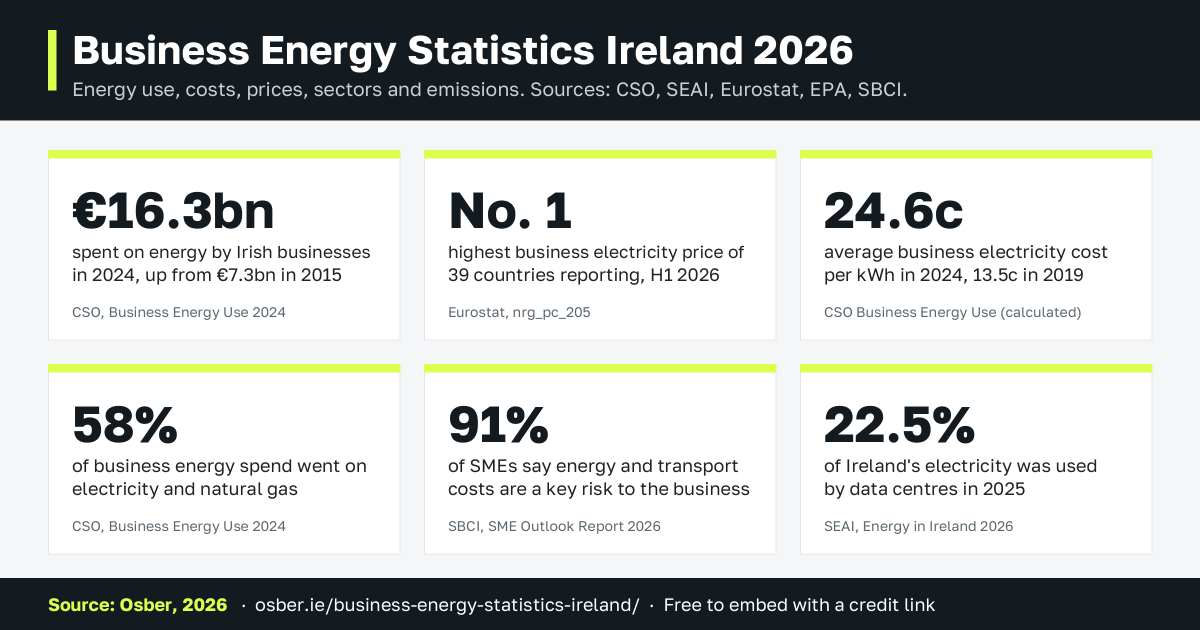
Irish businesses spent an estimated €16.3 billion on energy in 2024, more than twice the €7.3 billion they spent in 2015, and they now pay the highest business electricity prices of any country reporting to Eurostat. This page gathers the current statistics on business energy in Ireland: how much energy enterprises use and what it costs, which fuels and sectors account for it, how Irish prices compare with Europe, how electricity demand from data centres and other large users is changing, what businesses emit, and what support is available. Every figure links to the CSO, SEAI, Eurostat, EPA or SBCI source it came from, for journalists, business owners, facilities managers and researchers who need a number they can cite. It sits alongside our commercial building energy statistics, which cover the energy ratings of business premises.
Key Business Energy Statistics for Ireland at a Glance
- Irish resident enterprises spent an estimated €16.3 billion on energy in 2024, down 4% on €17.0 billion in 2023, while the quantity of energy they used rose by 1%. Source: CSO, Business Energy Use 2024.
- Electricity and natural gas made up 58% of business energy costs in 2024, at €5.9 billion and €3.5 billion. Source: CSO, Business Energy Use 2024.
- Businesses paid an average of 24.6 cent per kWh for electricity in 2024, against 13.5 cent in 2019 (calculated). Source: CSO, Business Energy Use 2024.
- In the first half of 2026, Irish businesses using 500 to 1,999 MWh a year paid 26.66 cent per kWh for electricity, the highest of 39 countries reporting to Eurostat and 48% above the EU average (calculated). Source: Eurostat, nrg_pc_205.
- Smaller businesses using 20 to 499 MWh a year paid 30.71 cent per kWh, also the highest of the 38 countries reporting in that band. Source: Eurostat, nrg_pc_205.
- 91% of SMEs said rising energy and transport costs were a key risk to their business in 2026, up from 68% a year earlier. Source: SBCI, SME Outlook Report 2026.
- Commercial services, including data centres, used 42.1% of Ireland’s electricity in 2025, and data centres alone used 22.5%. Source: SEAI, Energy in Ireland 2026.
- Large energy users, including major data centres, accounted for 31% of all metered electricity in 2024, up from 15% in 2015. Source: CSO, Business in Ireland 2025.
- Industry and services together produced 40% of Ireland’s greenhouse gas emissions in 2023, and emissions per euro of modified national income fell by a quarter between 2018 and 2023. Source: CSO, Business in Ireland 2025.
- Emissions from heating commercial buildings rose by 8.3% in 2024 after a colder year. Source: EPA.

How Much Energy Irish Businesses Use
The CSO’s Business Energy Use survey measures the energy bought by enterprises in industry and services; it excludes agriculture, forestry and fishing, and it counts fuel bought abroad by Irish resident firms, such as aviation fuel, per the CSO’s Business Energy Use 2024 release of 3 September 2026. Enterprises used 14,146 kilotonnes of oil equivalent in 2024, 1% more than in 2023 and 16% more than in 2015 (calculated). Services used 58% of it and industry 42%. Services use has grown from 5,522 ktoe in 2015 to 8,273 ktoe, while industry use has fallen from 6,716 ktoe to 5,873 ktoe.
Transportation and storage used 44% of all business energy, 6,188 ktoe, and 92% of that was aviation fuel bought by Irish resident airlines. The electricity and gas sector used 22%. Leaving those two aside, the largest users were information and communication at 717 ktoe, food and drink manufacturing at 653 ktoe, basic metals at 574 ktoe and rubber, plastics and mineral products at 422 ktoe, per Table 3A.
The fuel mix is shifting. Business electricity use rose by 5% in 2024 to 24,064 GWh, and natural gas use by 4% to 49,143 GWh. Coal use fell by 41% and peat use stopped altogether, as peat burning power stations moved to biomass, while heavy fuel oil rose by 86% from a low base, per the CSO. Across the economy, commercial services used 4.3% more energy in 2025 than in 2024, the second largest increase of any sector after transport, and electricity met 81.3% of the sector’s energy demand, per the SEAI’s Energy in Ireland 2026.
What Businesses Spend on Energy
The estimated cost of business energy purchases, excluding VAT, was €7.3 billion in 2015, €9.1 billion in 2021, €16.4 billion in 2022, a peak of €17.0 billion in 2023 and €16.3 billion in 2024, per Table 1B. The quantity of energy used rose only 16% over the same period, so most of the increase reflects higher prices. Services firms paid €10.4 billion and industry €5.8 billion in 2024.
Dividing what businesses paid by what they bought gives an average cost per unit. The table shows the result for electricity and natural gas, calculated by Osber from the CSO’s spending and quantity tables. These are averages across every business, including very large users that negotiate lower rates, so smaller firms usually pay more.
| Year | Electricity spend | Electricity average cost per kWh (calculated) | Gas spend | Gas average cost per kWh (calculated) |
|---|---|---|---|---|
| 2019 | €2,582m | 13.5c | €1,444m | 2.8c |
| 2021 | €3,363m | 16.8c | €2,214m | 4.5c |
| 2022 | €5,587m | 25.9c | €3,135m | 6.2c |
| 2023 | €6,144m | 26.7c | €3,892m | 8.2c |
| 2024 | €5,915m | 24.6c | €3,528m | 7.2c |
Source: CSO, Business Energy Use 2024, Tables 2B and 2C; averages calculated by Osber, excluding VAT.
The average cost of business electricity was 82% higher in 2024 than in 2019, and the average cost of gas was about two and a half times higher (calculated). Electricity alone cost businesses €5.9 billion, or 36% of all energy spending, and natural gas €3.5 billion, or 22% (calculated).
Energy Use and Costs by Sector
The table shows energy use and spending in 2024 for the sectors most relevant to businesses that occupy offices, shops, hotels, factories and depots, from Tables 3A and 3B of the CSO release.
| Sector | Energy used 2024 (ktoe) | Energy spend 2024 | Spend change since 2015 (calculated) |
|---|---|---|---|
| Information and communication | 717 | €1,798m | +600% |
| Wholesale, retail and vehicle repair | 358 | €815m | +40% |
| Food, beverages and tobacco manufacturing | 653 | €790m | +117% |
| Accommodation and food services | 174 | €458m | +88% |
| Public administration | 218 | €448m | +54% |
| Construction | 264 | €430m | +110% |
| Health, residential care and social work | 156 | €350m | +140% |
| Education | 159 | €333m | +108% |
| Financial, insurance and real estate | 73 | €171m | +68% |
Information and communication, which includes data centres, has grown fastest: its energy use rose from 196 ktoe in 2015 to 717 ktoe in 2024 and its energy spending from €257 million to €1.8 billion. Hotels, restaurants and cafés used 26% less energy in 2024 than in 2015 but paid 88% more for it, and wholesale and retail used 20% less energy while paying 40% more (calculated), per the CSO. For these businesses, the rising bill has come from price rather than use, which is why cutting the heat a building needs matters as much as the tariff.
Irish Business Energy Prices Against Europe
Eurostat publishes electricity and gas prices for non-household customers every six months, excluding VAT and recoverable taxes. In the first half of 2026, Irish businesses consuming 500 to 1,999 MWh a year paid 26.66 cent per kWh for electricity against an EU average of 18.00 cent, the highest of the 39 countries reporting, ahead of Cyprus at 23.06 cent and Italy at 22.53 cent, per Eurostat table nrg_pc_205, updated 19 October 2026. Smaller businesses consuming 20 to 499 MWh paid 30.71 cent against an EU average of 21.65 cent, 42% more (calculated), again the highest of the countries reporting.
The gap has persisted. In the larger band, Irish business electricity cost 28.29 cent in the first half of 2023 and 25.52 cent in the second half of 2025, while the EU average fell from 21.51 cent to 18.37 cent over the same period, per Eurostat. Gas is closer to the European norm: businesses using 10,000 to 99,999 GJ a year paid 6.79 cent per kWh in the first half of 2026 against an EU average of 6.16 cent, seventh highest of 32 countries, per Eurostat table nrg_pc_203. Households face the same pattern, as our energy poverty statistics show.
Data Centres and Electricity Demand
Ireland’s electricity demand reached 34.1 TWh in 2025, up 3.7% on 2024. Commercial services, which include the ICT sector and data centres, used 14.3 TWh, or 42.1%, and accounted for the largest increase of any sector at 0.78 TWh, per the SEAI’s Energy in Ireland 2026, updated 22 October 2026. Data centres alone used 22.5% of all electricity in 2025 and account for 78% of the net growth in demand since 2015. The CSO’s measure points the same way: large energy users, a category including major data centres and industrial sites, consumed 31% of metered electricity in 2024 against 15% in 2015, per Business in Ireland 2025.
Heating Business Premises
Heat made up 34.2% of Ireland’s energy demand in 2025, at 49.4 TWh, and 88.6% of it was met by fossil fuels. Industry accounted for 37.1% of heat demand and commercial services for 6.7%, about 3.3 TWh (calculated), per the SEAI. Commercial heating is sensitive to the weather: emissions from heating commercial buildings rose by 8.3% in 2024 as a 6.3% rise in heating degree days pushed up gas and oil use, and commercial services produced 1.4% of national greenhouse gas emissions, per the EPA.
The buildings themselves are a large part of the picture. Of the 87,017 non-domestic buildings with an energy rating, 17.5% are rated F or G, as our commercial building energy statistics set out from CSO data. Newer premises do much better: almost 45% of non-domestic buildings built between 2020 and 2025 were rated A, per the CSO.
Business Emissions
Industry, including construction, and services together produced 40% of Ireland’s greenhouse gas emissions in 2023, with the electricity, gas and steam sector at 14% and manufacturing at 12%, and emissions per euro of modified national income fell by a quarter between 2018 and 2023, per the CSO’s Business in Ireland 2025 release of 25 February 2026. Energy use fell by 17% in the electricity, gas and steam sector and by 10% in manufacturing between 2018 and 2023, and those sectors’ emissions fell by 25% and 9%. Cement and other non-metallic minerals produced 47% of manufacturing emissions in 2023. Nationally, energy-related emissions fell by 3.6% in 2025 to 29.8 MtCO2eq, the lowest in over 30 years, per the SEAI. For commercial and public buildings, the EPA projects emissions to rise by 6.8% between 2018 and 2030 under existing measures, against a target cut of 45%, per the EPA.
What SMEs Say About Energy Costs
Energy has become the top concern for smaller firms. In the SBCI’s 2026 survey, 91% of SMEs named rising energy and transport costs as a key risk, up from 68% in 2025, ahead of the cost of materials at 86% and the availability of skilled labour at 76%, per the SBCI’s SME Outlook Report 2026, published on 2 September 2026. More firms are acting on it: 32% said they were actively investing in sustainability and planned to invest more, against 19% in 2025, and cost reduction was the most cited reason for green investment, at 43%.
Support Available to Businesses
The SEAI offers SMEs a €2,000 voucher towards a professional energy audit, with eligibility criteria updated from 12 October 2026, per its energy audits page. Its business energy upgrades scheme gives immediate approval for measures including wall and roof fabric upgrades, heat pumps and building controls, with a set payout based on business type and floor area, and up to €325,200 towards solar PV. Larger projects can receive up to €3 million through the EXEED scheme, and the Support Scheme for Renewable Heat pays up to 40% of the cost of a heat pump for businesses switching from fossil fuels.